by Queener Law | Jan 17, 2016 | Colorado, Kentucky, Tennessee, Trucking Accident
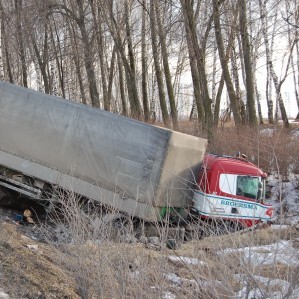
Each year, approximately 4,000 Americans lose their lives in truck related accidents, and another 85,000 are injured. Alarmingly, the number of fatalities due to big rig accidents has been steadily rising since 2009. According to the Unites States Department of Transportation, speeding is the leading driver related factor in accidents involving large trucks.
What is even more disturbing is that the level of damage incurred in an accidentwith a big rig increases with each additional mile per hour. At just 65 mph., it can take a fully loaded large truck nearly the distance of two football fields to come to a complete stop. Some states have raised their highway speed limits to 70, 75, 80 and even 85 mph. For large trucks, these limits are reckless and needlessly endanger the lives of truckers and other motorists.
Increased speed raises the risk for the driver to lose control in the event of a tire blowout as well. Since most large truck tires are only rated for 75 mph., and big rigs frequently travel long distances at speeds equal to the maximum or greater, the chance of experiencing a tire blow out is increased. Between 2009 and 2013, approximately 223 fatalities were related to large truck tire blowouts.
The American Trucking Association says it has been warning trucking companies, drivers, and the federal government of the dangers of speeding trucks for years. In 2006, the “ATA petitioned the National Highway Traffic Safety Administration and the Federal Motor Carrier Safety Administration to require the speed limiter on all large trucks be set in order to electronically limit their top speed to no more than 65 mph,” according to the ATA President and CEO Bill Graves. According to the ATA, requiring speed limiters on large trucks will reduce injuries, fatalities, and property damage due to big rig accidents.
In January of 2011, the government decided to move ahead with the mandate, but more than four years later, the ATA is still waiting. While the Federal Motor Carrier Safety Administration (FMCSA) has not indicated the maximum speed at which these limiters can legally be set, the ATA recommends a maximum speed of 65 mph. for large trucks weighing over 26,000 lbs. and traveling on roads with speed limits of 55 mph. or greater.
The Canadian provinces of Ontario and Quebec mandated electronic speed limiters for large trucks all the way back in 2009. Advocates claim that the year the law took effect, fatalities related to big rigs in Ontario dropped by an impressive 24 percent from the year before, despite an increase of 59 percent in the number of big rigs registered. .Approximately 70 percent of trucking companies in the United States already limit the speed of their trucks with similar electronic speed governors. According to safety advocates, that is 30 percent too few.
Benefits of Electronic Speed Limiters on Big Rigs
Although many truckers are against requiring the placement of electronic speed limiters on large trucks, many experts claim that there are numerous benefits to mandating them.
- Safety: With speeding being a leading cause of trucking accidents, mandating speed limiters would likely reduce the number of accidents that result in injuries, property damage and fatalities. As a result, safety ratings would improve.
- Lower Insurance Premiums: Better safety ratings would likely mean lower insurance premiums for trucking companies.
- Better Fuel Mileage: Slower speeds result in large trucks getting better fuel mileage.
- Repairs and Maintenance: Faster speeds are harder on large trucks, requiring them to have maintenance and repairs done more frequently. Additionally, traveling at speeds faster than tires are rated for can cause heat to build up and the rubber to be damaged, raising the risk for blow outs that could result in an accident, and will definitely result in the need for new tires.
The National Highway Traffic Safety Administration reports that it is in the process of developing a new rule that will soon mandate electronic speed limiters on large trucks. Additionally, the NHTSA is working on changing tire labeling requirements to include the maximum speed for which big rig tires are rated.
Although the impact that electronic speed regulators will have on safety is clear, those who are opposed to the mandate claim that it will cause highways to become congested and create slower moving traffic when the big rigs attempt to pass each other. This, in turn, could cause hundreds of thousands of frustrated drivers which can lead to road rage accidents.
How A Speed Limiter Works
An electronic speed limiter, also often referred to as a “governor”, operates through electronic sensors which calibrate the truck’s speed and transmit that information to the engine’s computer. When the vehicle reaches a preset maximum speed, the computer restricts the flow of air and fuel to the engine.
by Queener Law | Jan 11, 2016 | Tennessee, Trucking Accident
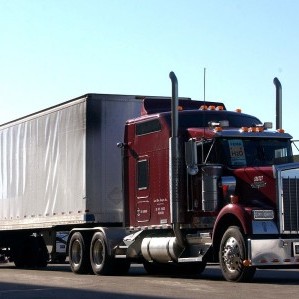
9.2 billion tons of freight were moved by truck across the United States in 2012. With a value of $13.6 trillion dollars, that is a weight equivalent of 25,000 Empire State Buildings with a value equal to 3/4 of the United States GDP. These massive numbers continue to grow in size and the monumental task of filling warehouse inventories and supplying the nation’s consumers is being conducted by 3.5 million truck drivers…many of whom are overloaded with both work and payloads.
As the nation’s consumer needs grow, many truckers are finding their vehicles overloaded with cargo as companies attempt to squeeze ever larger loads onto single vehicles in order to cut their transportation costs and maximize their profits. This is a direct violation of both state and federal regulations and is a growing problem within the trucking industry.
Federal Motor Carrier Safety Administration regulations require that cargo be firmly secured within a vehicle using the appropriate combination of tiedowns, wedges, chocks, cradles, shoring bars, and dunnage bags for the cargo being carried. These devices reduce the likelihood that a cargo will shift during transport and cause the vehicle to become unbalanced. Unbalanced and improperly loaded cargos are estimated to be the cause of 7% of serious truck accidents.
Moreover, vehicle overloading can cause axles, suspension systems, the powertrain, tires, or brakes to fail. It can also cause the frame of the vehicle to bend or split making the vehicle unsafe to operate. An overloaded vehicle will have an increased downhill speed, have difficulty climbing up hills, and will require greater distance to stop. It will also have an elevated center of gravity which makes it harder to steer and more prone to rolling over. Combined, overloading a commercial vehicle unnecessarily increases the risks that the truck will be involved in an accident.
In 2004, a AAA sponsored survey showed that 25,000 truck involved accidents were caused because cargo was improperly secured. A truck that is overloaded is more likely to roll, tip, or jackknife, In 2013, jackknifing was reported in 137 accidents, or 5% of all fatal trucking accidents. It’s further estimated that 15,000 trucks per year rollover causing nearly 12% of fatalities in accidents involving semi-trucks.
FMSCA statistics from 2013 showed that 83% of fatal truck accidents involved trucks whose Gross Vehicle Weight Rating (GVWR) was 26,000 lbs or greater. These large trucks are the most likely to be overloaded due to their size and the amount of cargo they can carry. By comparison, trucks with GVWR’s between 10,000 and 26,000 lbs were involved in 17% of fatality causing accidents. While suspected in many of these accidents, overloading was cited as a cause of the accident just .2% of the time.
What’s most concerning about these statistics is that 59.5% of the accidents involving GVWR’s of 26,000 lbs or greater involved vehicles that were carrying flammable liquids. A further 11% involved vehicles carrying explosives, gases, or other flammable solids. These secondary risk factors make collisions with overloaded vehicles carrying these materials especially lethal. And, because these cargoes tend to be destroyed during collisions, it makes it difficult to prove whether a vehicle was in fact overloaded even though law enforcement may strongly suspect overloading to be a contributing cause.
In Tennessee, trucking accident lawyers know that no commercial vehicle can carry a load that exceeds more than 20,000 lbs per axle, or 34,000 lbs per axle group. Further, the total gross weight of the vehicle may not exceed 80,000 lbs. Drivers whose trucks exceed these weight limits can be cited and fined accordingly. Overloading is something that law enforcement and the state’s weigh stations take seriously and regularly cite commercial vehicle drivers for. A driver and the company they work for can both be held liable for the load the vehicle is carrying, and failure to properly secure their load can constitute negligence if the vehicle is involved in a crash.
Can overloading be prevented? Currently, there are software programs that can tell a driver whether a vehicle is overloaded. Overload Protection Software (OPS) logs a vehicle’s axle data and gross loads, then compares this with the vehicle’s charted course. These systems then notify the driver whether their vehicle is overloaded for either its structural limits, or the roads that it will be taking. However, this software is not mandatory on commercial vehicles.
As such, drivers must pay careful attention to the weight and disposition of the cargo they are carrying. If they don’t, even the most innocuous cargo could transform the vehicle into a lethal weapon. To mitigate the risk of an accident, drivers should require company’s provide them with accurate information on the cargo’s composition, and take extra precaution during loading to ensure the vehicle is evenly loaded and the cargo properly secured. Doing so is the best way to ensure an accident free journey.
by Queener Law | Jan 5, 2016 | Colorado, Kentucky, Tennessee, Trucking Accident
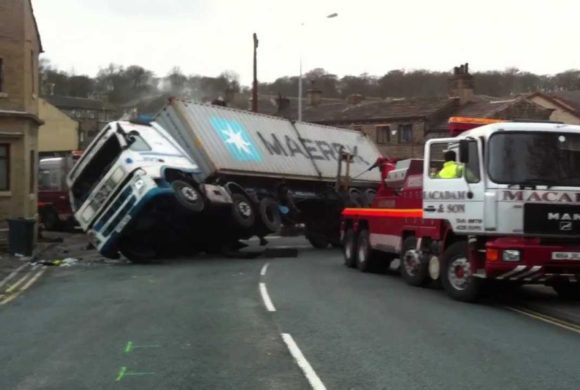
For many years now, tow truck drivers across the nation have been reluctant to upgrade their equipment to enable them to provide towing services for big rigs, cement trucks and other large, heavier vehicles. They would often cringe at the mere thought of being dispatched out to accidents and emergencies involving semi-truck and similar vehicles even if they did have the equipment that was necessary to provide service. This is largely due to the knowledge that they would likely end up facing massive fines resulting in thousands of dollars of added expenses for their company if they were caught operating their truck overweight.
Fortunately, things are about to change. A bill, commonly referred to as the Fair Tow Act, which was proposed in July of 2014 by U.S. Rep. Chuck Fleischmann, R-Tenn, will soon make it legal for tow truck operators to operate their trucks over the federal maximum weight limits on federal roadways as long as they are moving a large truck or other heavy piece of equipment away from the scene of an accident or emergency situation.
According to Fleischmann, the two main goals of the Act is to first, provide tow truck operators with the incentive to assist with removing these massive vehicles from roadways where they could cause additional dangerous accidents and possible injuries, and secondly, to get these broken down heavy vehicles out of harm’s way. The potential for heavy fines has been a deterrent to tow truck companies in the past, especially for smaller trucking companies who could be devastated by such costs.
The Fair Tow Act was initially introduced to the house as a stand alone bill, but was eventually incorporated into the high profile FAST Act long term highway and transportation funding act that has been making headlines for weeks. The inclusion of the Fair Tow Act into the well known highway act will have no bearing on the language of the measure, it will simply expedite the Act’s approval.
An approach by officials at Miller Industries, an internationally known manufacturer and supplier of tow trucks and equipment headquartered in Chattanooga, is what prompted Fleischmann to bring the proposal before his Congressional colleagues. According to William G. Miller II, president at Miller Industries, the company is frequently a voice for the towing industry, which is predominantly made up of small companies and entrepreneurs. According to Miller, trucks and other types of equipment have progressively gotten larger and heavier, and in response tow truck companies and owners have been pushed to buy or build larger trucks and mechanisms that can haul them. While some companies have attempted to use smaller trucks and lighter equipment to ensure that they are in compliance with weight limits, doing so can pose even more dangerous risks because of the lack of breaking capacity.
The Fair Tow Act is not a free ticket for tow truck drivers to haul large trucks and other heavy equipment in excess of weight limits on federal roads at will. It simply protects tow truck owners from receiving massive fines for removing heavy vehicles and equipment from accidents and emergency situations. As an added note, tow truck drivers will be required to drop heavy loads at the repair station nearest their location. Long hauls and those that are planned will still require that the company obtain special permits to be in compliance with the law.
Tow Trucks Will Not Be Exempt from Other Trucking Laws
Tow trucks will not be exempt from most other laws that pertain to the safety of large trucks. Anyone that uses a “commercial vehicle” to conduct business on the roadways is considered to be a motor carrier, and in most cases, tow truck drivers are included. While the FMCSA governs interstate truckers, drivers should be aware of state specific regulations in order to maintain safety as well. The key areas that these regulations focus on are:
- Carrier credentials
- Driver’s licenses and driver qualifications
- Drug testing
- Vehicle parts, accessories and maintenance
- Hours worked
- Vehicle inspections
If the tow truck driver is operating in support of an emergency or accident, however, some or all of the regulations do not apply. In the case of towing, a qualifying emergency includes:
- Any request from a law enforcement officer to assist with removing a vehicle or equipment from an accident or removing a disabled vehicle from traffic
- Operating in support of a declared disaster.
- Drug and alcohol still apply
To simplify things, when a tow truck driver is operating under normal tow truck driving conditions and not under one of the circumstances listed above, he or she is subject to the same rules and regulations that would apply to a commercial vehicle and driver.
by Queener Law | Dec 27, 2015 | Tennessee, Trucking Accident
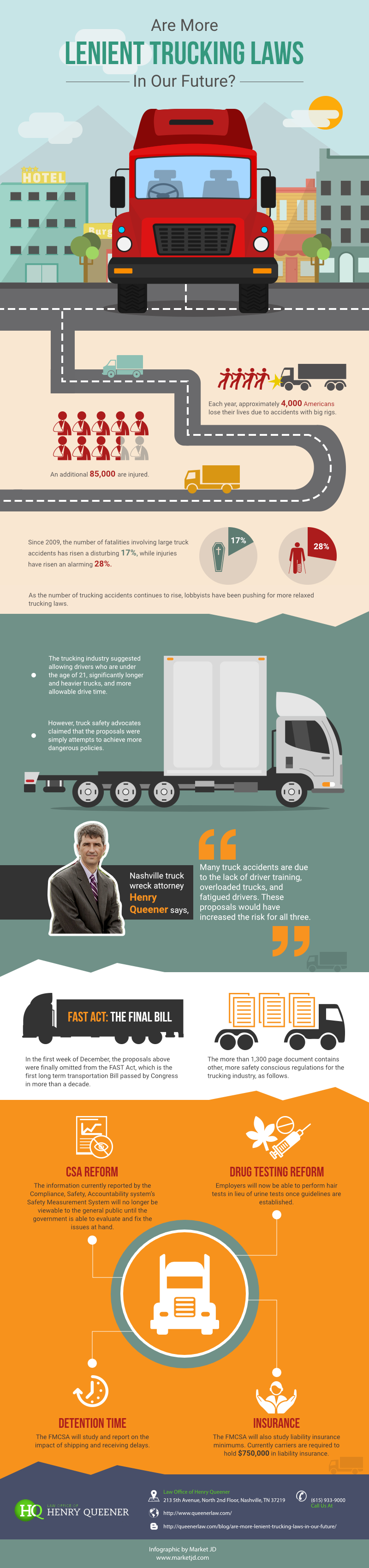
Each year, approximately 4,000 Americans lose their lives due to accidents with big rigs. An additional 85,000 are injured. Since 2009, the number of fatalities involving large truck accidents has risen a disturbing 17 percent, while injuries have risen an alarming 28 percent. As the number of trucking accidents continues to rise, lobbyists have been pushing for more relaxed trucking laws.
While the trucking industry’s wish list included allowing drivers who are under the age of 21, significantly longer and heavier trucks, and more allowable drive time, truck safety advocates claimed that the proposals were simply the trucking industry’s attempts to use Congress to achieve more dangerous policies. According to Nashville truck wreck attorney Henry Queener, “Many truck accidents are due to the lack of driver training, overloaded trucks, and fatigued drivers. These proposals would have increased the risk for all three.”
FAST Act: The Final Bill
The first week of December, the proposals above were finally omitted from the FAST Act, which is the first long-term transportation bill passed by Congress in more than a decade. Instead, the more than 1,300-page document contains other, more safety conscious regulations for the trucking industry.
- CSA Reform: The bulk of the information currently reported by the Compliance, Safety, Accountability system’s Safety Measurement System will no longer be viewable to the general public until the government is able to evaluate and fix the issues at hand.
- Drug Testing Reform: Employers will now be able to perform hair tests in lieu of urine tests once guidelines are established.
- Detention Time: The FMCSA will study and report on the impact of shipping and receiving delays.
- Insurance: The FMCSA will also study liability insurance minimums. Currently, carriers are required to hold $750,000 in liability insurance.
by Queener Law | Dec 21, 2015 | Colorado, Kentucky, Tennessee, Trucking Accident
The number of fatal accidents involving large trucks is on the rise in the United States, and federal investigators believe that a growing number of these accidents are caused by big rigs continuously traveling at speeds that are faster than their tires are rated for. Between the years of 2009 and 2013, there were approximately 14,000 fatal accidents across the nation that involved large trucks or buses. Of those, 223 were related to large truck tires.
Earlier this year, an investigation by the National Highway Traffic Safety Administration (NHTSA) revealed that multiple Michelin tire blowouts were caused from the lack of maintenance and large trucks traveling at high rates of speed. An increase in maximum speed limits in various states is partially to blame. According to the NHTSA, most truck tires are rated at 75 mph., and no truck tire is rated at higher than 81 mph. At this time, 16 states have maximum truck speed limits of at least 75 mph., and four states have set their maximum speed limits to 80 mph. Since 2009, injuries caused by large truck accident have risen an alarming 28 percent, while the number of fatalities has risen a disturbing 17 percent.
While the American Trucking Association (ATA) has been warning the federal government of the issue for years, and have requested that special electronic limiters that would cap a truck’s top speed at 65 mph. be required, the issue has yet to be resolved. According to the NHTSA, a new rule is being developed that will require the electronic limiters. At this time, only 70 percent of trucking companies limit the speed of their truckers. According to truck injury lawyer Henry Queener, “Lowering the maximum speed for truckers is not just an effective solution for the tire blowout epidemic, it will reduce the number of accidents caused by driving at excessive speeds as well”

by Queener Law | Jul 27, 2015 | Auto Accident, Tennessee
Poor road conditions create unsafe circumstances that contribute to serious and fatal collisions. Roads riddled with potholes and cracks severely damage cars, decreasing their operational efficiency and raising the risk for accidents.
According to an analysis from TRIP, a national transportation research group, United States’ roadways are in such poor condition that they cost the average American driver $515 a year in extra repairs, gas, insurance, and accidents. The primary funding source for streets and highways comes from the states. However, they are also heavily reliant on the federally-funded Highway Trust Fund which is quickly becoming insolvent. Moreover, Congress is thus far unable to agree on a long-term fix to keep the Fund solvent. Congress passed a temporary fix on July 31, 2014, which temporarily prevented insolvency, however, no long-term plan has been implemented.
Overview of the Problem and Cost to the Average Driver
Poor road conditions are present in all 50 states and the District of Columbia. According to TRIP, 28 percent of all U.S. roads are in “poor” condition. A “poor” condition designation means that the road is pitted with so many potholes, ruts, and cracks that it must be completely rebuilt (i.e., repaving is an insufficient fix).
The state of decay varies wildly from state to state. For example, 92 percent of roads in Washington, D.C. are rated “poor.” The next highest is California in which 51 percent of the roads are “poor,” followed by Rhode Island, New Jersey, New York, Washington, Wisconsin, Oklahoma, and Michigan. Luckily, Tennessee has some of the best roads in the county. A mere 11 percent are rated “poor.”
The cost of driving on these roads is similarly, widely varied. California, the District of Columbia, Oklahoma, and four other states can all expect to pay over $600 a year in additional costs. Conversely, Tennesseans pay less than $300 a year due to bad roads.
How did it come to this?
The primary funding source for the Fund is the gasoline tax. However, Congress did not peg it to inflation and has not raised it since 1993. The result is steadily declining tax revenue for the Trust Fund. Raising taxes is difficult because voters immediately internalize the cost of the tax but do not appreciate the long-term effects like car accidents and repairs to their vehicles that are due to poorly maintained roads.